A thousand-year-old recipe
The roots are Arab. The soul is Palermitan.
A thousand years on, the recipe is still the same. Not out of nostalgia: because there was nothing to improve.
Between the 9th and 11th centuries, under Arab rule, a new habit reached Sicily: grinding chickpeas into flour. Mixed with water and cooked over fire, it becomes a dense paste that is left to cool and then sliced.
The stroke of genius comes later, and it is entirely Palermitan: someone takes those slices and drops them into hot oil. Panelle are born.
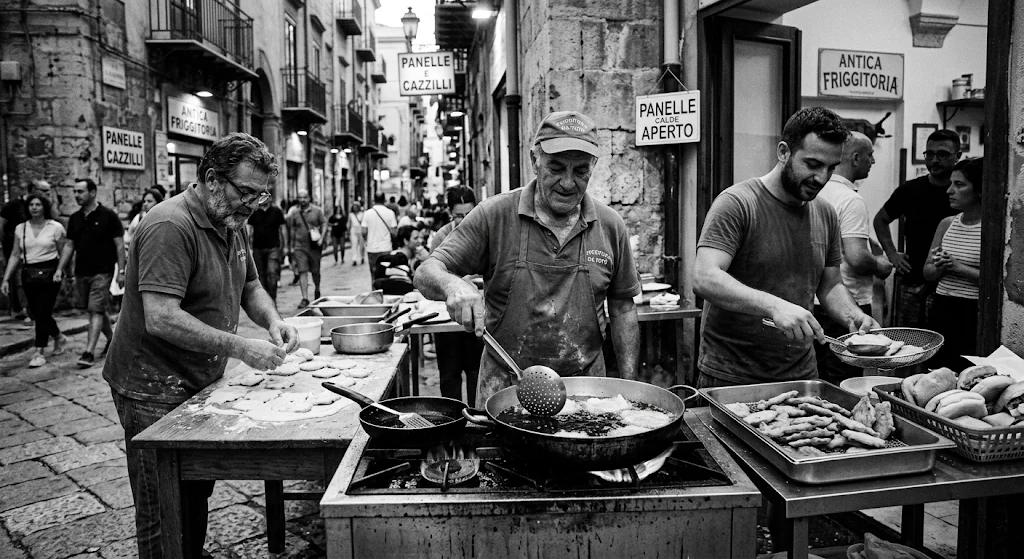
Palermo · the friggitoria
- 9th–11th century
The Arabs bring chickpea milling to Sicily. Flour and water, cooked over fire: the simplest way to preserve and portion food when no other way of preserving it existed.
- Palermo, later
The slices end up in hot oil. The recipe takes the shape it still has today: chickpea flour, water, salt, parsley.
- The panellari
Street vendors fry to order outside schools, markets and offices. Hot, good, very cheap food for people who worked and had no time.
- 20th century
A food born poor enters the pages of Pirandello, Sciascia and Camilleri, and becomes one of the island’s recognisable symbols.
- Today
Outside Sicily, almost nobody has ever tasted them. Not because they aren’t good: because nobody had ever taken them out.
From Sicily to every Italian table.
The prejudice
We were taught that street food is a guilty pleasure.
Street food never had to change. What is finally changing is the way we look at it.
Heavy. Greasy. All bread and deep-frying. Delicious and guilty — something you allow yourself on a Saturday, not something you choose. And for exactly that reason street food is never granted any nutritional dignity: it is entertainment, not nourishment.
Then you look at how Sicilian street food actually came about, and you find the exact opposite. Panelle were born where there was nothing to waste. Ground chickpeas, water, salt, a herb. There was no money to add anything, so nothing was added.
Out of that poverty came a food that today — without a single line of the recipe having changed — suits people with coeliac disease, people who are lactose intolerant, people who eat plant-based and people who read labels.
About us
Sikelia was the name of Sicily, before it was called Sicily.
The name is Greek, the recipe is Arab, the result is Sicilian.
The Greeks used Sikelia almost three thousand years ago for the land where everything grew. We chose that name because it says something simple: we are not inventing anything here.
We are taking out of Sicily something that already existed, made properly and without shortcuts, so that it can be discovered and enjoyed on tables all over Italy.
The manifesto
Four things we don’t negotiate.
These are not slogans: they are the criteria by which we decide what goes into the product and what does not. If we ever broke one of them, it would mean we had changed trade.
Few ingredients, all of them readable.
If you can’t recognise it on the label, we don’t put it in the product.
We take nothing away, because there is nothing to take away.
Our recipes were not adapted to anyone’s requirements. They reached us this way.
Italian raw materials only.
From the chickpea flour to the parsley. A short supply chain, suppliers with a name.
Technology is there to remove, not to add.
Cold exists precisely so that we never need additives.